
Talking to the Future
What I learned as a youth campaigner at United Nations discussions on Autonomous Weapons

By Lauren Barnard, Stop Killer Robots Youth Network Member
In early March, I joined the Stop Killer Robots delegation at the March 2026 session of the Group of Governmental Experts (GGE) on emerging technologies in the area of lethal autonomous weapons systems (LAWS) at the United Nations in Geneva. The session included five days of formal discussions between state diplomats, international organisations, academia, and civil society. Youth participation in multilateral discussions such as these is important on multiple levels - for young people generally, the youth participants themselves, and more experienced colleagues working on disarmament.
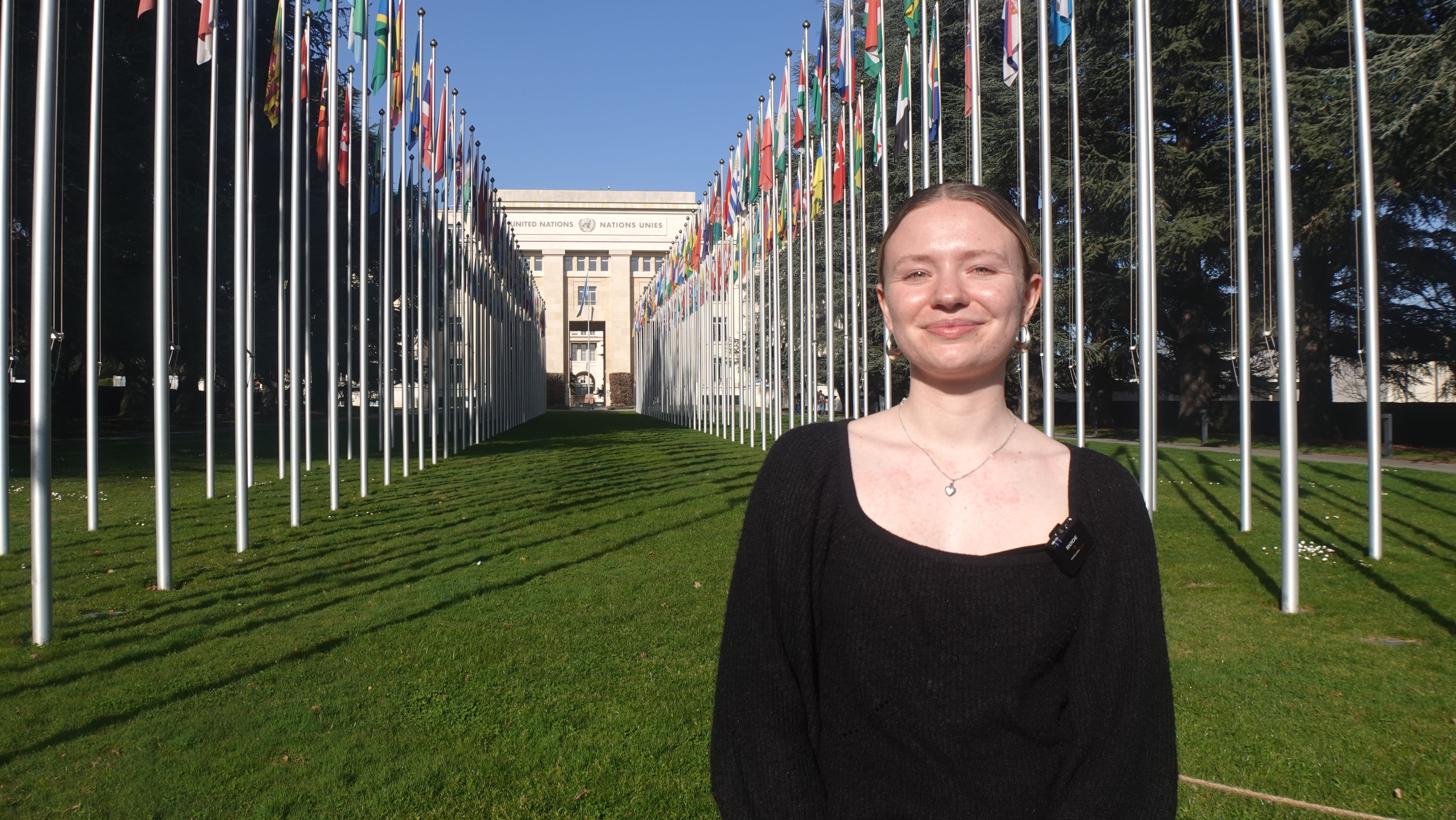
The GGE is currently discussing a ‘rolling text’ - a set of elements for a potential instrument to ensure the use of autonomous weapons is in line with international humanitarian law. I spent the week in Geneva speaking with diplomats, attending side events, and developing and delivering statements emphasising the campaign’s mission to maintain meaningful human control over the use of force.
For me, as for any other young person who gets to participate in something like this, this was an incomparable experience. At March’s GGE I was one of the youngest people in the room. I was invited as part of the Stop Killer Robots Youth Network and ended up being the sole member who could attend. As such, my attitude coming into the GGE was one of slight anxiety. I understood the importance of this week for the regulations being discussed, whilst also feeling the pressure of being a young delegate and representing the Youth Network. I wanted to put my best foot forward and more importantly, take away as much as possible from the week. I did just that, gaining valuable experience and skills.
“It is a powerful feeling to be listened to by colleagues and state representatives. Being in this space gave me the confidence that I can influence the opinions of others and navigate this world”.
— Lauren Barnard
For young people generally, it is crucial that there be meaningful youth representation during these discussions. The issues being discussed and the world that is being shaped outside of the walls of the GGE will be inherited by mine and future generations. Younger generations have grown up in a digital era, which gives us a unique and valuable perspective on the benefits and challenges of emerging technologies. This perspective is seldom heard in multilateral discussions, but they undoubtedly would benefit from it. Furthermore, young people need to be in the room to understand what is happening. It is only by being present in these spaces that we can learn the language of this world and develop influence. High-level diplomacy is something I don’t think you can prepare for. There is a language and culture around these discussions, in the way that diplomats and civil society interact, that cannot be taught - it has to be learnt through doing. I learnt a great deal over this week and met so many amazing people working in this field. It is a powerful feeling to be listened to by colleagues and state representatives. Being in this space gave me the confidence that I can influence the opinions of others and navigate this world.
For colleagues in the room, I think my presence was valuable. I may be at an early stage in my career, but I still have expertise, lived experience, and insight to meaningfully contribute to multilateral policy decisions that will inevitably impact the world I live in.
On day three of the GGE I delivered a statement on the importance of adequately understanding the effects of autonomous weapons system and taking steps to mitigate algorithmic and automation bias. I asked to deliver this statement as it resonated with my personal and academic convictions. The mitigation of algorithmic bias is one of the campaign’s core messages and it is vital that these concerns are addressed in the elements of a future instrument. There must be legal safeguards in order to prevent existing harmful societal biases such as racism, sexism and ableism, from being replicated and sanctioned by the use of lethal force.
I wrote my undergraduate dissertation on the impacts of automation bias on human operators of autonomous weapons systems. Automation bias is the phenomenon of human over-reliance and deference to the recommendations of automated systems. I feel strongly that this is an issue of great concern, which has not always been reflected in discussions. The mitigation of automation bias is key to ensuring that any human control over AWS is meaningful, and not in name only.
The text being developed by the GGE is only a recommendation for a set of potential elements and, as we were repeatedly reminded, not the negotiation of a treaty. However, it is still important that the language being developed and the issues covered strengthen international humanitarian law and address the reality of the impact these systems could have on individuals participating in or subjected to conflict. Whilst some states do not approve of civil society participation in these discussions, we are there for a reason: to remind states what is at stake.
One final topic which I felt driven to explore at the GGE was the issue of funding. I had many conversations around this as funding is of course the backbone of civil society participation in multilateral discussions. Personally, my participation was only possible due to receiving a scholarship from the University of Edinburgh. I am incredibly lucky to attend an institution with such generous alumni and a scholarship programme which prioritises students’ career development. Without this scholarship there unfortunately would not have been a youth participant from the campaign present throughout the week at this GGE. Many young people deserve to have this experience, regardless of their institutional background. Autonomous weapons and the increasing integration of artificial intelligence in our lives, and unfortunately, in the use of force, is an issue that will affect us all. We all deserve the opportunity to participate in discussions that will dictate how this will progress and share our perspectives.
Lauren Barnard is a graduate in European Legal Studies from the University of Kent and currently undertaking an LLM in Innovation, Technology and the Law at The University of Edinburgh. Lauren is a researcher and campaigner for the Stop Killer Robots United Kingdom and Youth Network chapters. She is also the Operations Manager at Lawyers for Nature.
If you would like to get involved or support youth participation in disarmament discussions learn more about the Stop Killer Robots Youth Network or email Charlotte Akin, Campaign Programs & Engagement Officer, charlotte@stopkillerrobots.org.